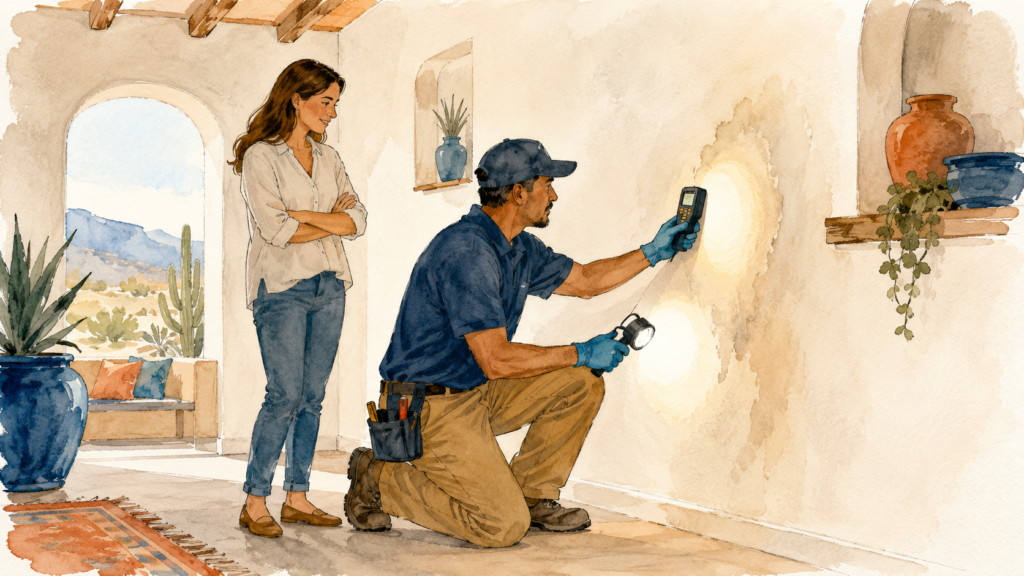
A homeowner near 59th Avenue had a small roof leak during last summer’s monsoon. The ceiling stain dried in a few days, she painted over it, and figured that was that. Three weeks later the guest closet on that side of the house smelled like a wet basement, and the paint above the top shelf had gone soft and dark.
Nothing dramatic happened in between. Her tile roof held up fine. But water had tracked along a truss and soaked the insulation inside the wall cavity, and that pocket never got a chance to dry. That’s how it usually goes here. The frightening part isn’t the storm. It’s the quiet weeks afterward, when moisture nobody found keeps feeding something behind your drywall.
And if you’re worried about black mold water damage in your Glendale home right now, the useful thing to understand is this: the color tells you almost nothing. Whether something in your house is still wet tells you everything.
Black mold, and why the label matters less than you think
“Black mold” usually means Stachybotrys chartarum, the species that earned a scary reputation in the news decades ago. It’s real, and it does turn up in homes after long, heavy wetting.
But the CDC’s position takes some of the fear out of this. There’s no evidence Stachybotrys is uniquely dangerous compared to other household molds, and no test can prove a link between it and a specific set of symptoms. The guidance is to treat all indoor mold growth the same way. One related point gets garbled constantly: some molds are toxigenic, meaning they can produce toxins under the right conditions, but that isn’t the same as the mold itself being poisonous.
So here’s the practical part: you can’t identify a species by looking at it, and you don’t need to. Plenty of harmless molds are black. Some Stachybotrys looks greenish. Your response is identical either way. Find the water, stop it, dry everything out, then remove the growth safely. You don’t have to solve a mystery. You have to solve a moisture problem.
How black mold water damage actually starts in a Glendale home
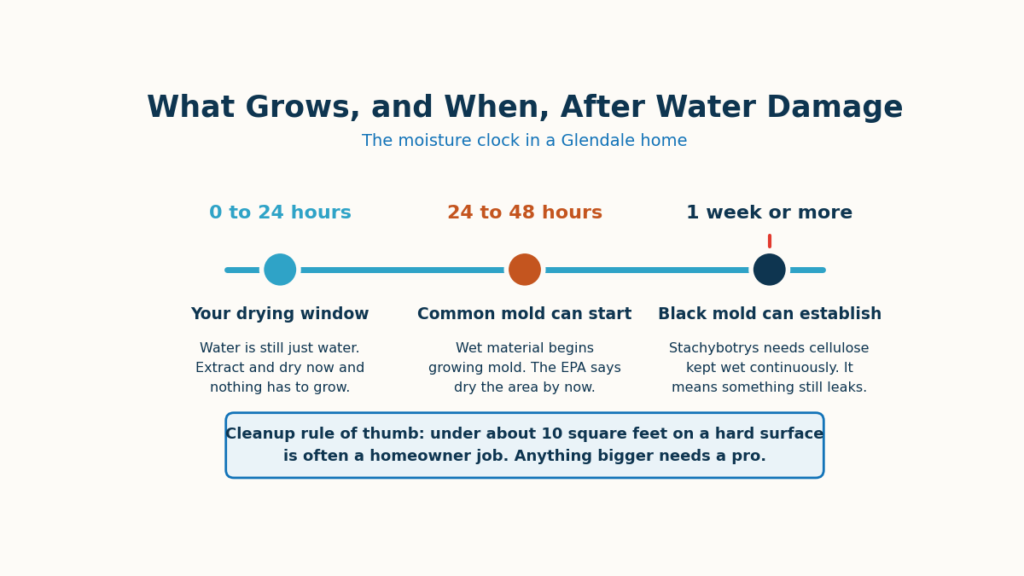
Mold spores are already in your house. They’re in every house, and they sit there doing nothing until they get water. Once a material gets wet and stays wet, common molds can start growing within 24 to 48 hours. That’s exactly why the EPA tells homeowners to dry water damaged areas and belongings inside that same window.
Stachybotrys is slower and pickier. It wants cellulose, meaning drywall paper, ceiling tile, cardboard, and wallpaper, and it wants that material wet more or less continuously. It generally needs a week or more of sustained moisture to establish itself, not a couple of damp afternoons. Our heat speeds all of this up rather than slowing it down.
Which is the whole point. If black mold has taken hold inside your wall, that isn’t really a mold story. It’s a story about water that’s been sitting there a long time, and something is probably still leaking.
The usual culprits around the West Valley: a monsoon roof leak that soaked insulation, a slab leak wicking up into the drywall, an AC condensation line backing up inside a wall, or a washer supply line that dripped quietly for months.

Signs to watch for after a leak
Smell usually beats sight
An earthy, wet cardboard smell is often the first honest signal, and it arrives before anything is visible. It’s strongest in enclosed spaces: a closet, the cabinet under a sink, a laundry room. Don’t file that away as normal. A musty smell in a climate this dry is a real clue, because there isn’t much else here that would cause it.
What you can see
- Spots or fuzzy patches on drywall, baseboards, or ceiling tile, in black, green, grey, or white
- Paint bubbling or peeling somewhere that used to be wet
- Drywall that looks faintly stained or feels soft when you press it
- Baseboards pulling slightly away from the wall
- A stain that keeps coming back after you paint over it
That last one deserves its own sentence. If a stain bleeds back through fresh paint, the material behind it is still wet.
Where it hides in Southwest homes
The spot you can see is often the small end of the problem. Growth settles where it’s dark and still: inside wall cavities, under tile, behind the toe kick of your cabinets, in the attic above a roof leak. A pro finds those places with a moisture meter instead of guessing, and hidden growth usually means wet drywall has to come out rather than dry in place.
Arizona homes are not immune to this
Plenty of Glendale homeowners assume the climate handles this for them. The air is dry, the summer is punishing, so surely anything wet just bakes off. It doesn’t work that way, for a simple reason: a wall cavity isn’t outdoors. Wet insulation sealed behind drywall dries very slowly no matter what your patio thermometer says, and the heat that’s supposed to rescue you works against you instead, because mold grows faster warm than cool.
Then add our local plumbing reality. Glendale sits on hard water that corrodes pipes over the years. Slab leaks are common in older West Valley neighborhoods. AC systems run for months straight making condensation the whole time. And monsoon season lands July through September with wind driven rain that finds roof flashing you’d forgotten existed. So we get less rain than almost anywhere and still see a steady stream of mold calls.
Common mistakes that make it worse
Most of the bad outcomes we hear about start with a handful of well meaning moves:
- Painting or caulking over it. That hides your warning signal. Mold works right back through paint.
- Bleaching porous material. On drywall or wood, bleach removes the color while the roots stay put. Fine on tile, not a remediation plan.
- Dry scraping or sanding it. The EPA warns against this specifically, because it throws spores through the whole house.
- Fixing the mold but not the leak. It comes back within weeks, in the same spot.
- Waiting to see if it dries on its own. The expensive one. Your clock runs in hours, not weekends.
When you can clean it yourself, and when to call someone
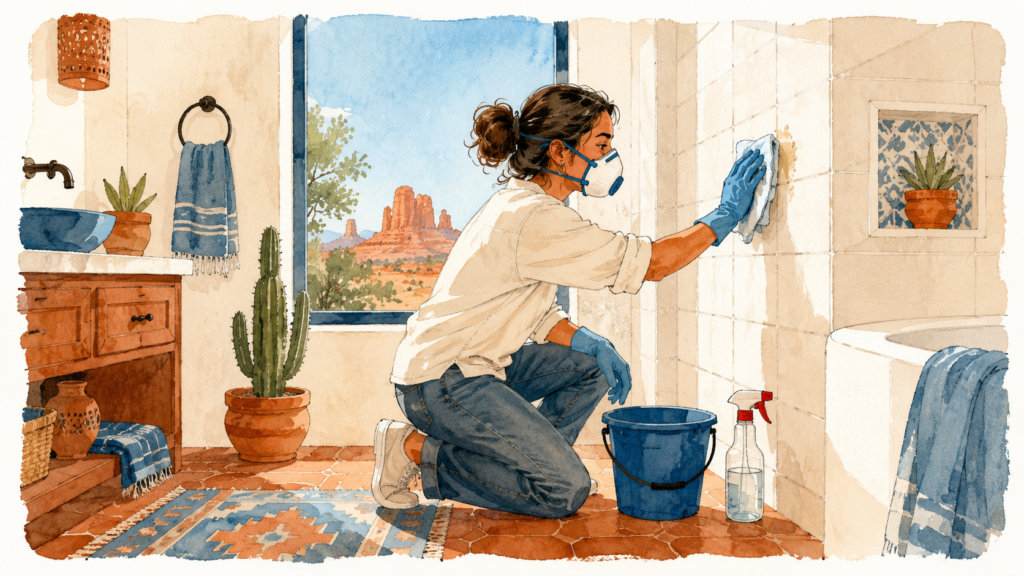
Not every case of black mold water damage needs a crew. The EPA draws a workable line here: growth smaller than about 10 square feet, roughly a 3 foot by 3 foot patch, can usually be cleaned up by a homeowner following EPA guidance. But that only makes sense if all of these are true:
- The patch is small and sits on a hard, non porous surface like tile, glass, or metal
- You’ve already fixed the leak or the moisture source
- The water was clean, not sewage and not storm runoff
- Nobody in the house has asthma, a lung condition, or a weakened immune system
- It hasn’t already grown back after a cleaning
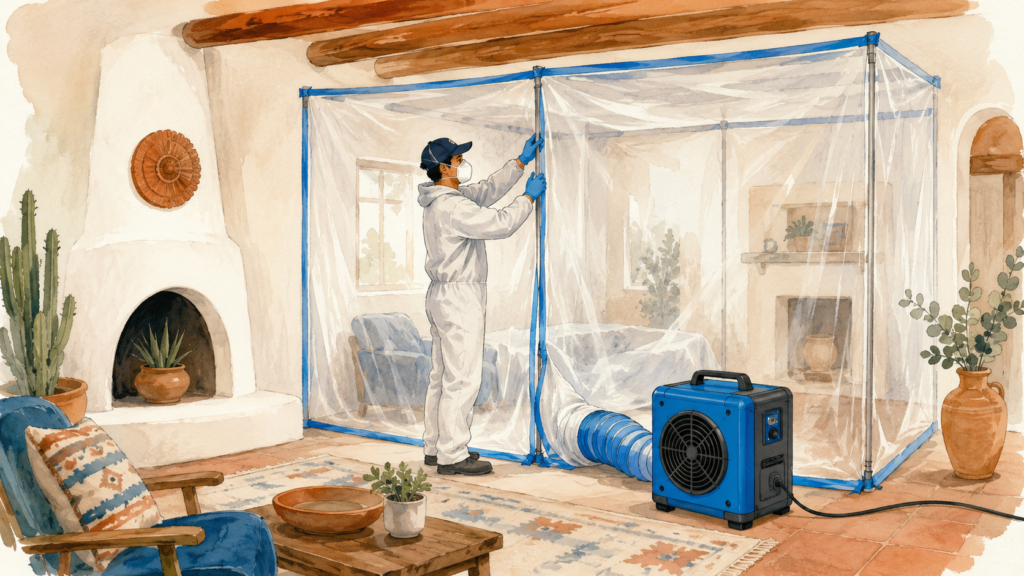
Call a professional when the area runs bigger than that, when the water was contaminated, when growth reached your HVAC system, when it’s inside walls or under flooring, or when someone at home is medically vulnerable. Bigger cleanups need containment, HEPA filtration, and negative air pressure so the work itself doesn’t spread spores through the house. And if growth followed a sewage backup, skip the decision tree. Call someone every time.
What to do next
- Stop the water. Close a valve, tarp the roof, call a plumber. Nothing else matters until this is done.
- Photograph everything before you touch it, for your insurer.
- Get air moving and pull the humidity down with fans and a dehumidifier.
- Leave visible growth alone and close the door to that room.
- Get a moisture inspection if you smell it but can’t find it.
- Call your insurer while the evidence is fresh.
On that last one, a quick reality check. In Arizona, standard policies commonly cover sudden internal water, like a supply line letting go, and often cover monsoon wind or hail roof damage. Mold coverage is usually limited, and often depends on whether the underlying water event was covered and whether you acted quickly. Slow leaks are commonly excluded, and flood needs a separate policy. Read your own policy or ask your agent, because the details vary a lot.
Key takeaways
- Color doesn’t identify a species, and species rarely changes what you do about it
- Common mold can start in 24 to 48 hours, so the drying window is short
- Black mold needs long, sustained wetness, which points at an ongoing leak
- A musty smell usually shows up before you see anything
- Under about 10 square feet on a hard surface is often a homeowner job
- Fix the water first or it simply returns
Frequently asked questions
Is black mold really toxic?
The CDC says there’s no evidence Stachybotrys is uniquely hazardous compared to other household molds. Anyone with asthma, a chronic lung condition, or a weakened immune system should be more cautious around any mold, and should talk with a doctor about symptoms.
How long does it take for black mold to grow after water damage?
Common molds can start within 24 to 48 hours on wet material. Stachybotrys typically needs longer, usually a week or more of continuous heavy moisture on cellulose like drywall paper.
Does homeowners insurance in Arizona cover mold?
Sometimes, and usually with limits. Coverage often hinges on whether the water event that caused it was itself covered and whether you responded quickly. Gradual leaks are commonly excluded. Check your policy, because it varies by insurer.
Getting help in Glendale
Almost every case of black mold water damage we hear about in the West Valley traces back to the same thing: water that sat longer than anyone realized. You don’t need to identify what’s growing in your wall. You need to know how far the water went.
So if you’re smelling something musty, or a stain came back through your paint, get it looked at while it’s still small. That part you actually control. You can see what local pros handle in our services section, and the EPA’s mold cleanup guidance covers the official version.
Glendale AZ Water Damage is a water damage information and lead request service. We’re not a licensed restoration contractor, and this article is general information, not professional restoration, insurance, or health advice. Every leak is different, so have a licensed local pro assess your specific situation.
Water spreads by the hour, and so does what grows after it. For fast 24/7 help from a local pro, call the number at the top of the page or reach out through our site and we’ll get someone headed your way.