
A neighbor of mine in an older part of Glendale, off 51st Avenue, noticed her baseboards felt a little soft one morning while she was vacuuming. No puddle, no drip, nothing dramatic. Just a spongy spot where the wall met the floor that she almost ignored. Three weeks later a plumber found a pinhole leak in a supply line that had been weeping behind the drywall the whole time.
That’s how trouble usually shows up in a West Valley home. Not with a flood, but with a small clue that’s easy to explain away. Water travels behind walls, under tile, and through the slab for weeks before anything looks obviously wrong, and in the Arizona heat that quiet stretch is exactly when mold gets started.
The good news is your house almost always warns you first. The signs of hidden water damage tend to be subtle: a faint musty smell, a stain that keeps coming back, paint that bubbles for no reason, a water bill that creeps up. Catch them early and you’re looking at a small repair. Miss them through a Glendale summer and you can end up with warped floors, ruined drywall, and a mold problem. Here’s what to watch for in an older home, and what to do the moment something feels off.
Why older Glendale homes hide water damage so well
Older West Valley homes were often built with plumbing that gives out slowly over the years. Galvanized steel supply lines and cast iron drains corrode from the inside, and even copper can develop pinhole leaks where decades of Glendale’s hard water and mineral buildup have worn it thin. A leak that starts as a slow weep can run for a long time before it ever reaches a surface you can see.
Most Glendale houses also sit on a concrete slab, so many of the water lines run under the floor. A slab leak can soak the ground beneath your home for weeks and never leave a drop you’d notice, because the water has nowhere to pool where you’d see it.
Then there’s our dry air, which quietly works against you. A small leak that would show up fast in a humid climate can evaporate off the surface here, so the wall looks dry while the inside stays soaked. That trapped moisture is the real danger, because Arizona heat can grow mold within 24 to 72 hours once conditions are right. By the time you smell it, it’s usually been busy for a while.
The signs of hidden water damage to watch for
You don’t need special tools to catch most of these. You just need to know what your house is telling you. Any one of these on its own might be nothing. Two or three together usually mean water is moving somewhere it shouldn’t.
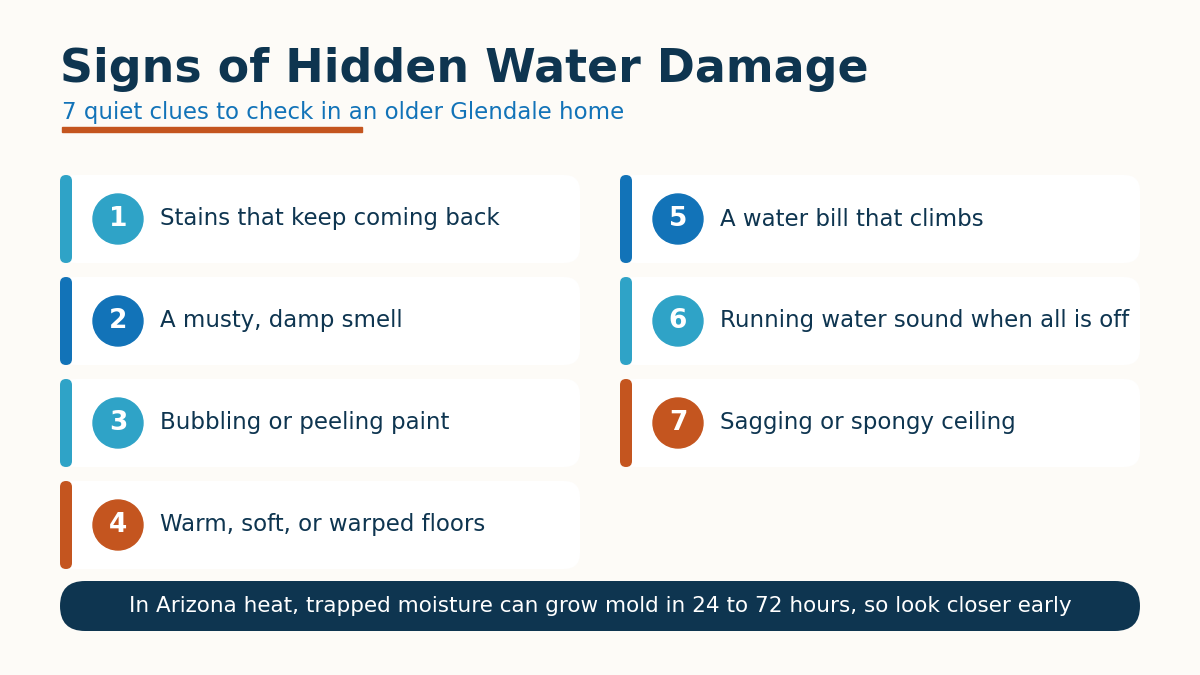
- Stains that keep coming back. A yellow or brown ring on a ceiling or a dark patch near a baseboard is water leaving a mark. If it returns after you paint over it, the source is still active.
- A musty or damp smell. That mildew odor in a closet, cabinet, or hallway is often the very first clue, and it usually shows up before any stain does.
- Paint or wallpaper that bubbles, peels, or cracks. When moisture gets behind the surface, it pushes the finish loose from the wall.
- Floors that feel warm, cool, soft, or warped. A warm spot on tile can point to a hot water slab leak. Cupping or buckling in wood or laminate means moisture underneath.
- A water bill that climbs for no reason. If your usage habits haven’t changed but the bill jumped, a hidden leak is one of the most common causes.
- The sound of running water when everything’s off. Turn off every faucet and appliance, then listen. A faint hiss or trickle in a wall or the floor is worth chasing down.
- Sagging drywall or a spongy ceiling. If a ceiling looks like it’s sinking or feels soft when you press it gently, water has saturated the material above.
One more that Glendale homeowners miss: your water meter. Turn everything off, then check whether the meter’s little flow indicator is still spinning. If it moves with no water running, something is leaking between the meter and your house.
Where hidden water tends to hide in a West Valley home
Knowing where to look cuts your search in half. These are the spots that hide leaks most often in older Glendale homes, so they’re worth a two minute check every month or so.
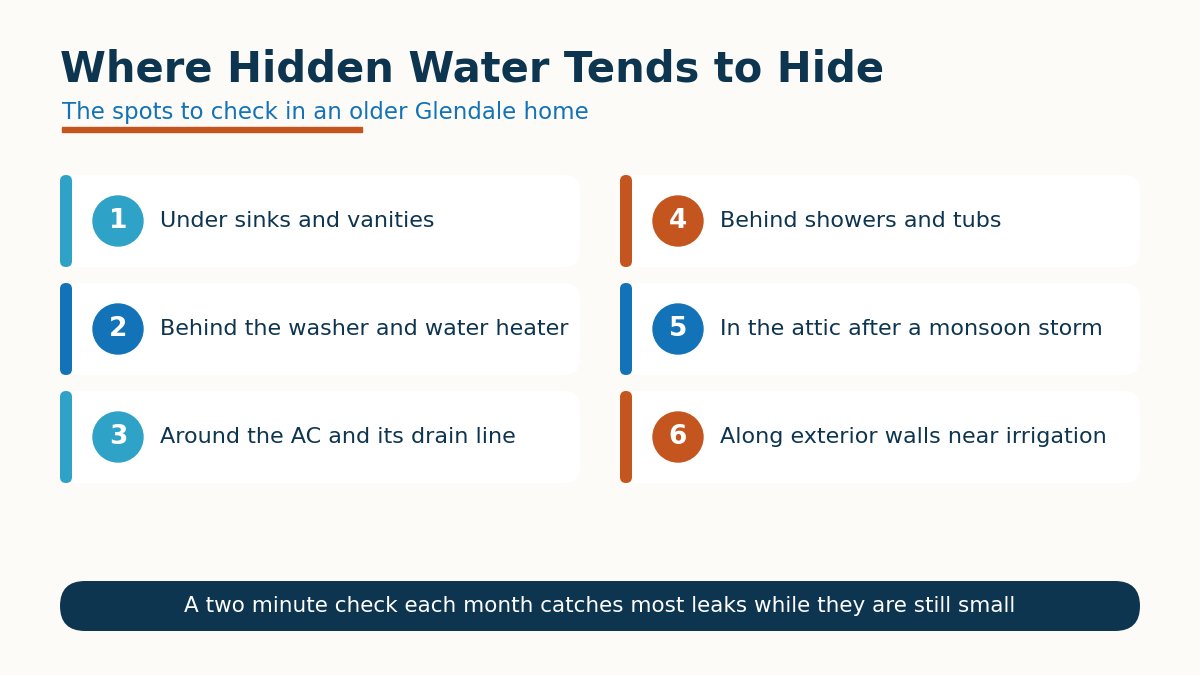
- Under kitchen and bathroom sinks, where supply lines and drain fittings loosen over time.
- Behind the washing machine and around the water heater, especially in a hot Glendale garage where hoses dry out and crack.
- Around your air conditioner’s indoor unit and the condensate line. In summer a clogged drain line can drip inside a wall or ceiling for weeks.
- Under and behind showers and tubs, where old grout and worn caulk let water slip past the tile.
- In the attic, under any roof penetration, after a monsoon storm has driven rain into places it doesn’t usually reach.
- Along exterior walls where landscape irrigation runs close to the foundation.
Monsoon season, roughly July through September, is prime time for the roof and attic spots. A little wind driven rain finds a worn flashing or a lifted shingle, then works its way down into the ceiling. If you had a big storm and then noticed a fresh stain a week later, the two are probably connected.
Common mistakes homeowners make
The biggest one is painting over a stain instead of finding the leak. Fresh paint hides the mark for a few weeks, but the water keeps coming and the damage behind the wall keeps growing. A stain that returns is your home asking for help, not a paint problem.
Another is assuming our dry desert air means a small leak already dried out. Surfaces dry fast here, but the wall cavity, the subfloor, and the space under the slab can stay wet and warm, which is exactly what mold needs to take hold. Waiting to see if a musty smell fades on its own usually just gives it more time.
The last one is doing nothing because there’s no visible puddle. Hidden damage is dangerous precisely because it’s hidden. The homeowners who come out of this cheapest are the ones who treat a soft baseboard or a returning stain as a reason to look closer today, not next month.

What to do when you spot the signs
Start by finding the source if you safely can. Check under the nearest sinks, look at the water heater and washer hoses, and run that water meter test. If you can tell where it’s coming from and it’s a simple fixture, a plumber can often stop it fast.
If the water is spreading, the ceiling is sagging, or you can’t find the source, shut off the water to that fixture or at the main valve and get help. The faster wet materials get dried out, the more of them you can save. A pro can use a moisture meter to find water you can’t see and set up fans and a dehumidifier to dry the wall or floor before mold starts.
Here’s how that plays out in real life. A couple near Arrowhead in an older home kept catching a faint musty smell in their guest bathroom but saw nothing wrong. They finally pulled the vanity out and found the wall behind it damp and darkening from a slow drain leak. Because they caught it while the spot was still small, the fix was a section of drywall and a day of drying rather than a gutted bathroom. That’s the whole point of learning the signs of hidden water damage: they turn a big emergency into a small one.
Key takeaways
- Hidden water damage rarely announces itself. Watch for stains that return, musty smells, bubbling paint, soft or warm floors, and a rising water bill.
- Older Glendale homes are more prone to it because of aging pipes, slab construction, and hard water wearing lines thin.
- Dry air hides leaks on the surface while moisture stays trapped inside, and heat can start mold in 24 to 72 hours.
- Check the leak prone spots monthly, and use the water meter test to catch a leak you can’t see.
- When in doubt, look closer today. Early action is the difference between a small repair and a major one.
Frequently asked questions
How can I tell if water damage is old or new?
A fresh leak usually leaves a darker, damp stain with defined edges, and the spot feels wet or soft. Older damage often looks dry, with rings, a yellowed tint, and sometimes a wrinkled or flaking surface. If you’re not sure, a moisture meter settles it quickly by reading what’s still wet inside.
Does homeowners insurance cover hidden water damage in Arizona?
It depends on the cause. Standard Arizona policies commonly cover sudden accidental leaks, and they often cover monsoon wind or hail roof damage. Damage from a slow leak you left unaddressed, or from a maintenance issue, is commonly denied, and flood usually needs a separate policy. Your specific coverage depends on your policy and your insurer.
Should I test my home for mold if I only smell it?
A musty smell is a strong reason to find and fix the moisture, which matters more than testing. For a small area you can often clean it yourself once it’s dry. For a larger spot, repeated growth, or anyone in the home with breathing issues, bring in a professional to assess it.
How often should I check an older Glendale home for leaks?
A quick monthly look at the common hiding spots is plenty for most homes, plus an extra check after any big monsoon storm. It takes a few minutes and catches most problems while they’re still cheap to fix.
Glendale AZ Water Damage is a water damage information and lead request service. We are not a licensed restoration contractor, and this article is general information, not professional restoration, insurance, or health advice. A licensed local pro should assess your specific situation.
If you’ve spotted the signs and want a set of trained eyes on it, see how we help Glendale and West Valley homeowners or reach out for fast 24/7 help. Finding hidden water early is the best money you’ll ever spend on your home.