You’re standing in the hallway of your Glendale home, towel in hand, watching water spread across the tile. Your first instinct is probably to stop it and start drying. But there’s a question a restoration crew asks before anything else, and the answer shapes everything that follows: where did this water come from?
That source decides the water’s category. Clean water from a supply line gets handled one way. Water that sat under your house for two days in the Arizona heat gets handled a very different way. Understanding the three water damage categories helps you know what you’re actually facing, why a pro treats each one differently, and what it can mean when you file a claim.
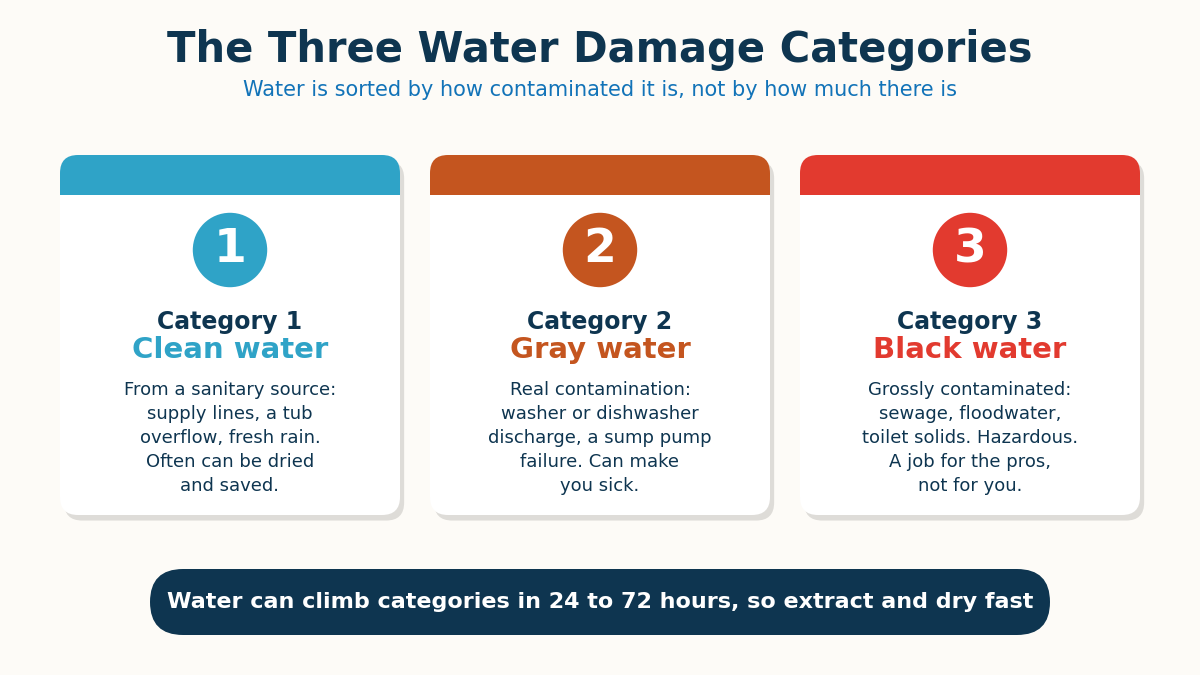
Restoration pros lean on a widely used industry standard that sorts water into Category 1, 2, or 3 based on how contaminated it is. It’s less about how much water you have and more about what’s in it. Here’s what each one means for your home.
What water damage categories really measure
Category isn’t about the size of the mess. A slow drip under a sink and a burst pipe in the ceiling can both be clean water. What sorts them is the source and the level of contamination, meaning the bacteria, chemicals, or organic material the water is carrying.
That distinction matters because contamination changes how a room gets cleaned, what can be saved, and what has to go. Clean water on your subfloor is a drying problem. Contaminated water on that same subfloor is a health problem that usually means removing whatever it touched.
Knowing the category early keeps you from an expensive misstep, like trying to dry out and reuse carpet that should have gone in the trash.

Category 1: clean water
Category 1 is clean water from a sanitary source. Think a broken supply line to a faucet, a bathtub that overflowed with the tap running, or the fresh water line to your fridge or water heater. Rain that comes in before it picks up anything dirty can start here too.
At the moment it escapes, this water poses little risk to touch or breathe around. It’s the best case if you have to have water damage at all. Materials it soaks, like drywall, baseboards, and flooring, can often be dried in place and saved if you move quickly.
The catch is that clean water doesn’t stay clean. Left sitting, it soaks up dirt, drywall dust, and whatever it flows across, and it starts sliding toward the next category. In a Glendale summer, that clock runs fast.

Category 2: gray water
Category 2, often called gray water, carries real contamination. It holds enough microorganisms or chemicals to make you sick if you swallow it or stay in contact with it. Common sources are a washing machine or dishwasher discharge, a sump pump failure, or a toilet overflow that’s urine but no solids.
Gray water isn’t a trip to the ER for most healthy adults, but it’s not something you mop up with a bath towel and call finished. It needs proper cleaning and disinfecting, and porous materials it soaked, like carpet padding, usually can’t be saved.
This is also where the category climbs if you wait. Gray water sitting in a warm Glendale room can turn into Category 3 within a day or two as bacteria multiply.
Category 3: black water
Category 3, or black water, is grossly contaminated and genuinely hazardous. It can carry harmful bacteria, viruses, and other pathogens. Sources include sewage backups, toilet overflows with solids, and floodwater from outside. That last one is a big deal during Arizona’s monsoon season, when storm runoff carries whatever the streets were holding.
This is not a doing it yourself cleanup. Category 3 water can make you seriously ill, so stay out of it and get a professional in protective gear to handle it. If you’re dealing with a sewage backup, our guide on what to do first with a sewage backup walks through the immediate steps.
Materials soaked by black water almost always have to be removed and replaced, not dried. The goal shifts from saving things to protecting your health.
Why the category can change over time
Here’s the part a lot of homeowners miss: a category isn’t fixed. Water can start as Category 1 and become Category 2, or even Category 3, the longer it sits and the more surfaces it touches.
Two things drive that slide. Time and temperature. Standing water collects contaminants from whatever it crosses, and warmth speeds up bacterial growth. Arizona’s heat is the accelerator here. A puddle that might take days to turn in a cool climate can degrade much faster in a Glendale home in July.
It’s the same reason a leak can grow mold in as little as 24 to 72 hours in our climate. The takeaway is simple. The faster clean water gets extracted and dried, the better your odds of keeping it in Category 1 and saving your floors and walls.
Categories and classes aren’t the same thing
A quick note, because these terms get mixed up. Categories describe how dirty the water is. Classes, numbered 1 through 4, describe how much water there is and how hard it’ll be to dry, based on how much material soaked it up.
A pro uses both. The category tells them how to protect everyone’s health, and the class tells them how much drying equipment the job needs. For you, the category is the one that affects your safety and often your claim, so it’s the one worth understanding.
What your category means for an insurance claim
Your water’s category doesn’t just guide the cleanup. It often shapes your insurance claim too, because it points straight to the source, and the source is what insurers look at.
In Arizona, standard homeowners policies commonly cover sudden and accidental internal water damage, like a pipe that bursts without warning. They also often cover roof damage from monsoon wind or hail. What they usually exclude is flood, the rising outside water a big monsoon storm can bring, which needs a separate flood policy.
So clean water from a burst supply line is often a straightforward covered claim, while black water from outside flooding is often excluded unless you carry flood coverage. Gray or black water from a leak ignored for months can be denied as a maintenance issue. None of this is guaranteed, and every policy is different, so document everything with photos, note when you first saw the water, and call your insurer early. For more, see our guide to whether Arizona homeowners insurance covers water damage.
Common mistakes homeowners make
A few missteps turn a manageable problem into a much bigger one:
- Treating every leak like clean water. Mopping up a toilet overflow with towels and reusing them just spreads contamination.
- Waiting to call. Every hour lets the category climb and gives mold a head start.
- Running fans over Category 2 or 3 water. Air movers can blow contaminants around a room before it’s been cleaned and disinfected.
- Reusing soaked carpet padding. It’s cheap to replace and nearly impossible to truly clean once gray or black water hits it.
- Assuming your claim will be denied, or that it’s guaranteed. Neither is safe to assume, so let the process play out.

What to do next
Picture a homeowner near 59th Avenue and Union Hills here in Glendale. A hose behind the washing machine let go while they were at work, and they came home to a soaked laundry room and hallway. Because a washer discharge line is involved, that’s Category 2 gray water, not clean.
They did the right things. They shut off the water, kept the kids and the dog out of the wet area, took photos, and called for help instead of dragging box fans over it. That’s the playbook: stop the source if you safely can, stay out of anything contaminated, document it, and get a professional assessment.
A pro will confirm the category, extract the water, and set the right drying plan, and they’ll do it before the Arizona heat turns a Category 1 or 2 problem into something worse. If you want a sense of the whole timeline, our overview of the water damage restoration process in Glendale lays it out step by step.
Key takeaways
- The three water damage categories sort water by contamination, not by how much of it there is.
- Category 1 is clean water, Category 2 (gray) carries real contamination, and Category 3 (black) is hazardous and a job for pros.
- Water climbs categories the longer it sits, and Glendale’s heat speeds that up, with mold possible in 24 to 72 hours.
- Your category often shapes your insurance claim. Arizona policies commonly cover sudden internal water but usually exclude flood.
- The fastest way to keep water in Category 1 and save materials is to extract and dry it right away.
Frequently asked questions
What are the three categories of water damage?
The three water damage categories are Category 1 (clean water from a sanitary source), Category 2 (gray water with real contamination), and Category 3 (black water that’s grossly contaminated and hazardous). They’re sorted by how contaminated the water is, not by how much there is.
Can Category 1 water become Category 3?
Yes. Clean water picks up contaminants the longer it sits and the more it touches, and warmth speeds that up. In Arizona’s heat, water can slide from clean to gray to black faster than many people expect, which is why quick extraction matters so much.
Is gray water dangerous?
Gray water can make you sick if you swallow it or stay in contact with it, so it needs proper cleaning and disinfecting rather than a quick mop up. It’s smart to keep very young, elderly, or immune compromised family members out of the area until it’s handled.
Does insurance cover all water damage categories?
Not automatically. Coverage depends on the source, not just the category. Arizona policies commonly cover sudden internal water, often cover monsoon roof damage, and usually exclude outside flooding unless you carry a separate flood policy. Every claim is different, so document the damage and check with your insurer.
Glendale AZ Water Damage is a water damage information and lead request service. We’re not a licensed restoration contractor, and this article is general information, not professional restoration, insurance, or health advice. Categories, coverage, and costs vary by home, insurer, and situation, so a licensed local pro should assess yours.
If you’re dealing with water right now, don’t wait for it to climb a category. Call anytime for fast 24/7 help, or reach out through our site and we’ll connect you with a local Glendale pro who can start drying today.